

 (707) 433-8888


TMJ/TMD in Healdsburg, CA
Jaw pain can show up when you chew, yawn, talk through a long meeting, and even first thing when waking up. Many people live with it for years before mentioning it to anyone, partly because it comes and goes and partly because it is not obvious who to ask. It is a reasonable thing to bring to your dentist. The joints, muscles, and teeth involved are all part of the same system, and evaluating how that system works together is a routine part of the care we provide.
Contact Us

Quick Links
What is Temporomandibular Joint Dysfunction (TMD)?
The temporomandibular joint (TMJ) is the hinge that connects your lower jaw to your skull, just in front of each ear. It is one of the most complex joints in the body because it both rotates and slides, and it is the only joint that has to coordinate with an identical joint on the other side of your head while a set of teeth dictates exactly where it can come to rest. It’s a precise system that requires precise care when something in that arrangement is not working smoothly.
TMJ and TMD are often used interchangeably, but they are different. TMJ refers to the jaw joint itself, while TMD refers to temporomandibular disorders affecting it and the surrounding jaw muscles. The causes are rarely singular, which is part of what makes these conditions frustrating to sort out. Teeth grinding and teeth clenching place pressure on the joint and the muscles that operate it. A jaw injury from a fall, a collision, or a blow to the face can damage the joint or displace the small cushioning disc inside it. Arthritis, including rheumatoid arthritis, can affect the joint the way it affects any other. Habits like gum chewing, nail biting, and chewing on pens keep the jaw muscles working when they should be resting. Stress contributes to nearly all of it, because the jaw is one of the most common places the body stores tension. Sometimes the joint simply wears in a way that produces symptoms, and no clear cause is ever identified.
TMD Symptoms
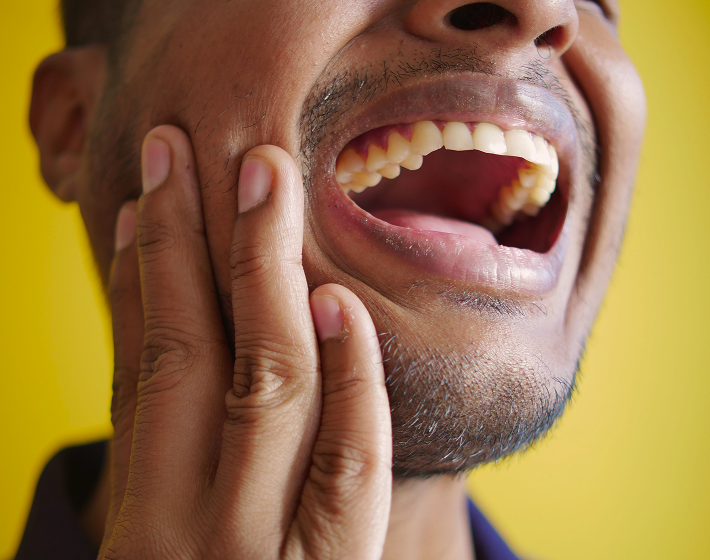
TMD does not present the same way in everyone, and the symptoms can be surprisingly diffuse. Common signs include:
- Aching or tenderness in the jaw joint, especially in front of the ear
- Pain that radiates into the temples, face, or neck
- Headache, particularly on waking
- Clicking, popping, or grating sounds during jaw movement
- A jaw that locks, catches, or will not open as wide as it used to
- Difficulty or discomfort when chewing, or a bite that suddenly feels off
- Worn, flattened, chipped, or sensitive teeth
- Ear pain, fullness, or ringing with no infection present
- Tightness or fatigue in the jaw muscles by the end of the day
- Shoulder or neck pain that has no other clear explanation
Because these overlap with sinus problems, ear infections, and other sources of oral facial pain, an accurate diagnosis matters before treatment begins. Dr. Griffith will examine your joints and muscles, evaluate your bite and jaw movement, review your dental history, and take images as needed to understand what is actually driving your symptoms.
YOUR OPTIONS
Treatment Options for TMJ Disorders
The guiding principle of TMJ treatment is to start with the most conservative option that can reasonably work and to escalate only if it does not. This reflects the recommendations of the National Institute of Dental and Craniofacial Research, and it aligns with how we approach every other aspect of care in our practice. Several different options can be used to relieve TMD symptoms, including:
Self-Care and Rest
Most people improve with self-care and time. Resting the joint helps a great deal, which means eating soft foods for a stretch, cutting out gum chewing and nail biting, avoiding wide yawns, and being deliberate about keeping your teeth apart when your mouth is at rest. Moist heat eases muscle tightness, while cold can help with acute pain and swelling. Gentle stretching and relaxation techniques address the stress and tension that so often sit underneath the physical symptoms.
Occlusal Splints
Occlusal splints are the most common dental intervention and are frequently the turning point. A splint, sometimes called a nightguard or bite guard, is a custom appliance worn while you sleep. It protects your teeth from grinding, allows the jaw muscles to relax, and lets the joint settle into a more comfortable position. A poorly made appliance can make symptoms worse rather than better, which is why we take our own records and work with laboratories we trust to craft a custom nightguard rather than dispensing something off the shelf.
Pain Relief
Nonsteroidal anti-inflammatory drugs (NSAIDs) can reduce inflammation and provide short-term TMJ pain relief while other measures take hold. Additionally, muscle relaxants are occasionally prescribed for short periods. Physical therapy is valuable for many patients, particularly for restoring range of motion and retraining the muscles that control jaw movement, and we refer to therapists who work regularly with the jaw and neck. Other treatments, including trigger point injections and behavioral approaches to managing clenching, may be worth exploring for ongoing pain.
Restorative Dental Care
Where the bite itself is contributing, targeted restorative work can help distribute forces more evenly. Dr. Griffith is careful about this. Permanently altering teeth to treat TMD is not a first-line approach, and it should follow a clear diagnosis and a period of reversible treatment rather than precede one. A small minority of cases eventually involve maxillofacial surgery. Temporomandibular joint surgery is a last resort rather than a starting point, and if your case is heading in that direction, Dr. Griffith will refer you to a TMJ specialist or oral surgeon who does that work regularly.
Who Should Consider TMJ Treatment?
It is worth being evaluated if jaw pain has become a regular feature of your life rather than an occasional annoyance. Chronic pain in the jaw, face, temples, or neck deserves attention, and so does a jaw that clicks loudly, catches, or has begun limiting how wide you can open. If you wake with a sore jaw or a headache most mornings, if your partner has mentioned hearing you grind at night, or if you notice your teeth wearing flat or chipping without an obvious cause, those are all reasons to have your joints and bite examined.
Timing is worth thinking about, too. TMD that has been present for a few weeks after a jaw injury or a stressful stretch often responds quickly to simple measures. Symptoms that have persisted for months or years generally take longer and benefit from a more structured approach, which is another argument for not waiting. Anyone experiencing severe pain, a jaw that has locked open or closed, or a sudden change in how their teeth fit together should be seen promptly rather than waiting to see whether it resolves.


What Our Patients Say
“It really comes down to the personal experience with Dr. Griffith. He’s a one of a kind. Not often do you get to go see your dentist and have them actually form a cool patient/doctor relationship with you, address all of your dental concerns you may feel uncomfortable about and he’s looking out to get you taken care of in Dr. Griffith fashion. A truly talented DDS.”
What Our Patients Say
“Great dental team! I appreciate Dr. Griffith taking the time to understand and discuss my health, as well as to explain options that met my needs and budget. He is very knowledgeable about various aspects impacting dental health, which I haven’t experienced before with other dentists. The team works well together. They made sure I was comfortable and thoroughly explained what they were doing. I highly recommend this office for basic cleaning, improving dental health, whitening, and for kids.”
What Our Patients Say
“I recently saw Dr. Griffith for the very first time, and I'm so glad I chose his office.”
What Our Patients Say
“I’ve been seeing Dr. Griffith for many years, and I can’t recommend him enough. He’s attentive, professional, and has a great sense of humor that always helps me relax during visits. I trust his judgment, he gives honest advice and never makes me feel pressured to have extra procedures.”
What Our Patients Say
“I couldn’t be happier with my experience working with Dr. Griffith. He and his staff take every precaution to ensure your comfort throughout the visit, answer all questions, and the results are everything I had hoped.”
What Our Patients Say
“Austin has always been great to work with, and will take the time to help me understand the options I had. Unfortunately I have spent too many hours in a dentist chair, way more experience than any person should have, but this gives me a great perspective on the person doing the work. Couldn’t ask for more, professional, polite, knowledgeable, and friendly dentist. My dentist for life”
What Our Patients Say
“Dr. Griffith is a wonderful dentist. He takes the time to listen and provides quality work. Great experience.”
What Our Patients Say
“Austin Griffith is one of those rare dentists who makes you forget you’re sitting in a dental chair at all. From the moment he walks into the room, there’s a calm, steady confidence that immediately puts you at ease. He takes the time to listen, explains everything clearly without talking down to you, and approaches his work with a level of care that feels both professional and genuinely human.”
What Our Patients Say
“I have been a patient of Dr. Austin Griffiths for well over a decade. He is quite extraordinary in that his skill as a dentist is coupled with his great empathy for his patients as individuals, so the level of care he provides feels well beyond the usual doctor patient experience. He is gifted in his ability to resolve complex dental issues while simultaneously making his patients feel secure in the knowledge he sees them as singular complex individuals with needs that may shift from time to time. I feel Im visiting a caring friend when I must see my dentist. I can’t recommend Dr. Griffiths highly enough.”
What Our Patients Say
“I actually had fun at the dentist today! It was like a spa experience. The clinic is familiar but the dentist is new. Dr Griffith took over the clinic when my longtime friend and dentist retired. I thought it would lose the family feeling but it did not. It still feels so warm and welcoming; the whole staff is wonderful, especially Destiny and Dr Griffith. (They are the ones who worked on my teeth) I am not great at the dentist, everything hurts me and I normally have immense anxiety but I almost fell asleep today I was so relaxed. It felt like a spa day and I wished the procedure lasted longer. 😂”
What Our Patients Say
“Great touch. I was really relaxed, not fond of getting dental work.”
What Our Patients Say
“I have not been to the dentist for nearly 3 years And had generally built up a small amount of hesitation in going again. Thankfully, Austin and the team are amazing to work with and have got my teeth back on the right track. Cannot recommend them highly enough”
What Our Patients Say
“Dr. Griffith was very personable. He seems like a happy man. My first impression of him today was very good and I look forward to other appointments with him in the future.”



Why Choose Dr. Austin Griffith, DDS
We are passionate about dentistry, health, and craftsmanship, and we strive to create an environment where patients feel comfortable, respected, and genuinely cared for. We understand that the dentist makes people anxious, especially when they are experiencing pain or discomfort. Our office is calm by design, appointments aren’t rushed, and sedation is available when it would help.
In many modern healthcare settings, visits can feel rushed and impersonal. We believe there is value in slowing down, building relationships, and providing care in a more thoughtful and personal way. This personal attention of a traditional practice is combined with the precision of modern dentistry. We use cutting-edge technologies, stay up-to-date with continuing education, and partner with like-minded laboratories and specialists who work to create the finest dentistry we know. When you visit our office, Dr. Griffith will curate a custom treatment plan tailored to your needs, consult with you about the options, and answer any questions you might have so that you can make an informed decision that’s right for you.
Meet the Doctor
Our Philosophy
Clinical precision meets genuine care, this is dentistry you can rely on, every single time.
Learn More

Blogs
Answers on dental care, procedures, and what to expect, comprehensive care starts here.
Learn MoreSchedule an Appointment
Our office is located in Healdsburg, just outside Santa Rosa, and we welcome patients from throughout Sonoma County. If your jaw hurts, clicks, or tires easily, or if you suspect you have been grinding your teeth, we would be glad to take a look and see if a temporomandibular joint disorder is contributing to these symptoms. Schedule an appointment today and let us help you relieve pain, protect your teeth, and get back to eating, talking, and sleeping with ease.
We can’t wait to see you smile.
Every smile is unique. We take the time to listen, understand, and create a plan just for you.